
The lawyer found us in the last row of the church just as people were leaving Mr. Vance’s funeral. He walked straight to my eighteen-year-old son, Noah, and handed him a thick envelope.
“Are you the boy who mowed Mr. Vance’s lawn every Saturday?”
Inside were four envelopes, each written in Mr. Vance’s familiar handwriting: Saturday One. Saturday Two. Saturday Three. Saturday Four.
His children, Aaron and Claire, stared in shock. They had never seen them before.
The lawyer explained that Mr. Vance had left one final request: Noah had to open exactly one envelope every Saturday.
Noah gave a quiet laugh. “That’s him.”
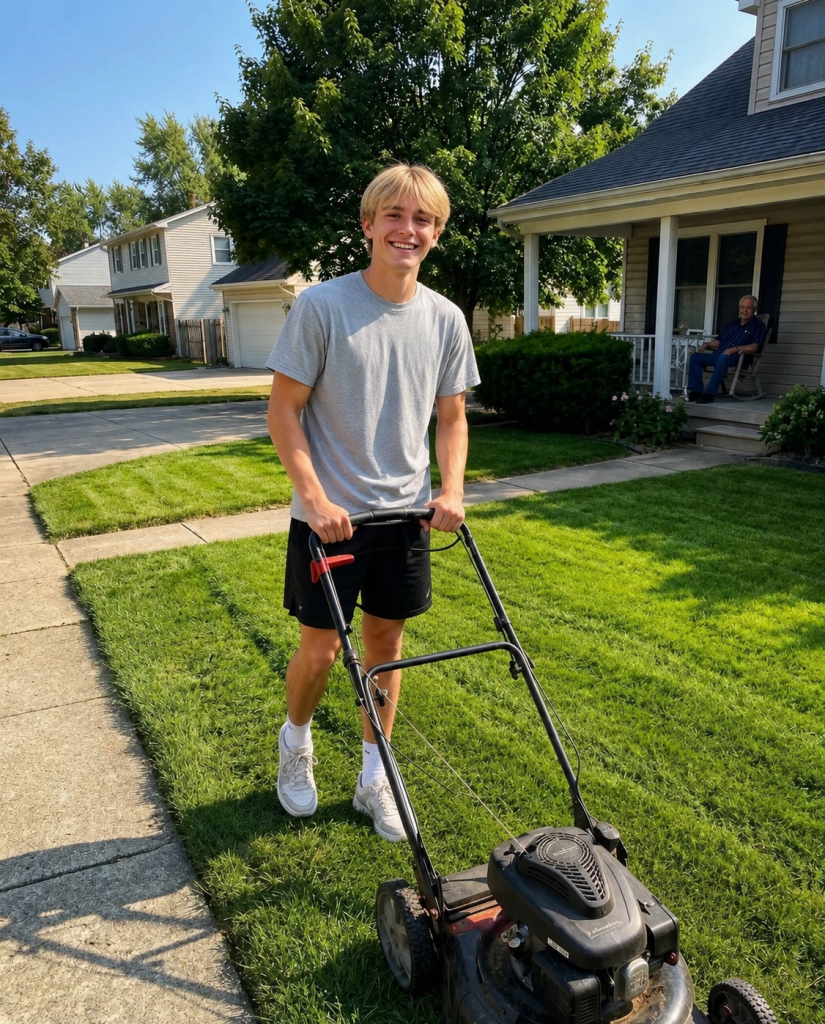
For four years, Noah had crossed the street every Saturday to mow Mr. Vance’s lawn. I had raised Noah alone, always afraid that growing up without a father would leave a hole in him. Instead, he became the kind of boy who noticed people others overlooked.
Mr. Vance was a lonely widower. His wife, Margaret, had died years earlier, and he spent most days sitting silently on his porch.
Noah never asked for money. Through summer heat, winter cold, exams, and even the morning after prom, he kept showing up.
They barely talked.
But now we were beginning to understand that those quiet Saturdays had meant far more than any of us realized.
Saturday One led Noah and Claire to an old diner. A woman named Ruth gave them a box Mr. Vance had left with her months earlier.
Inside were Margaret’s handwritten recipes—including the cinnamon rolls Claire remembered from childhood.
Claire held one recipe against her chest and whispered, “I stopped making them because the house didn’t smell right anymore.”
Saturday Two sent Noah and Aaron to Franklin Field with an old baseball glove.
There, Aaron learned the truth about his father.
Mr. Vance had secretly watched three of his grandson Ben’s baseball games from beyond the outfield fence. He had wanted to walk closer, but the grief of losing Margaret made the bleachers unbearable.
“I should have walked closer,” he had written.
Aaron finally broke down, crying for the father he had spent years believing simply didn’t care.
Then came Saturday Three.
It was for Noah.
The instructions said only:
My house. Porch chair.
Under the old wooden chair where Mr. Vance had spent countless Saturdays, Noah found a small notebook.
Nearly every page was dated.
And almost every date was a Saturday.
Mr. Vance had written about Noah arriving in the heat, coming in the rain, looking exhausted during exams, learning to drive, parking too close to the mailbox, and getting ready for graduation.
He had noticed everything.
Even the days Noah looked troubled.
On the final page, one sentence was underlined:
Need to tell him thank you properly.
Noah had spent four years believing he was just mowing the lawn of a lonely old man who barely noticed him.
He was wrong.
Mr. Vance had been quietly watching his life unfold.
Later, Aaron found one entry that made everything fall into place:
Boy reminds me of Aaron.
Maybe Noah had reminded Mr. Vance of the son he had lost touch with. Maybe those quiet Saturdays had given him a chance to feel close to someone again.
Claire got a piece of her mother back.
Aaron realized his father’s silence had not always meant indifference.
And Noah finally learned that his kindness had never gone unnoticed.
There was still one envelope left.
Saturday Four.
None of us knew what was inside.
But by then, I understood something.
Whatever Mr. Vance had left in that final envelope, it could never be more valuable than what he had already given them.
Because sometimes, the smallest acts of kindness—showing up, week after week, without asking for anything in return—can become the most important part of someone’s life.
And sometimes, people say “thank you” long after they’ve run out of time to say it themselves.