
The doctors had already prepared us for the worst.
My father’s liver was failing.
The once-strong man who had taught me how to ride a bicycle, fix a leaking faucet, and never give up was slowly disappearing before my eyes. His skin had turned yellow, his body had grown weak, and every hospital visit seemed to bring more bad news.
One evening, as I sat beside his hospital bed listening to the steady rhythm of machines, a transplant specialist quietly entered the room.
“There may be another option,” she said.
I looked up hopefully.
“A living liver donor.”
I had never heard those words before.
The doctor explained that unlike most organs, the liver has a remarkable ability to regenerate. A healthy person can donate part of their liver, and over time, both the donor’s remaining liver and the transplanted portion can grow back.
It sounded impossible.
It sounded terrifying.
But as I looked at my father sleeping in that hospital bed, there was only one question in my mind.
“What do I need to do?”
The weeks that followed felt like an endless series of tests, scans, blood work, and interviews. Doctors examined every part of me. They wanted to be certain that I was physically strong enough to survive the surgery and emotionally prepared for what lay ahead.
One psychologist asked me gently, “Why do you want to do this?”
I didn’t hesitate.
“Because I want more time with my dad.”
The day they told me I was a match, my father cried.
“No,” he said immediately. “I’m not letting you risk your life for me.”
I took his hand.
“You spent your whole life protecting me,” I told him. “Now it’s my turn.”
The morning of the surgery arrived far too quickly.
As nurses prepared me for the operating room, fear finally caught up with me. I wasn’t afraid of pain. I wasn’t even afraid of the scar.
I was afraid of not waking up.
Because despite all the medical advances, this was still major surgery. Healthy people were not supposed to willingly surrender part of an organ.
Yet there I was, lying on a hospital bed, about to do exactly that.
My father was being wheeled into another operating room at the same time.
For a brief moment, our eyes met across the hallway.
“I love you,” he whispered.
“I love you too,” I said.
Then the doors closed.
When I woke up, pain hit me like a wave.
Every breath hurt.
Every movement hurt.
The incision across my abdomen burned, and exhaustion settled so deeply into my bones that even lifting my head felt impossible.
I quickly learned that recovery wasn’t measured in days.
It was measured in tiny victories.
Sitting up alone.
Taking a few steps.
Walking to the bathroom without assistance.
There were moments when I wondered if I had made a mistake.
Moments when the pain felt endless.
But every difficult step became worthwhile the day a nurse wheeled me into my father’s room.
He looked different.
Stronger.
Color had returned to his face.
For the first time in months, he smiled.
Real tears filled my eyes.
We didn’t need words.
The monitors beside his bed told the story for us.
His new liver was working.
He was going to live.
Recovery continued long after we left the hospital. Fatigue lingered for months. There were countless follow-up appointments, blood tests, and anxious moments waiting for results.
But something else changed too.
Our relationship.
We had always been close, but surviving this together created a bond that is difficult to describe. It wasn’t simply gratitude. It was something deeper—a shared understanding that life itself had become our greatest gift.
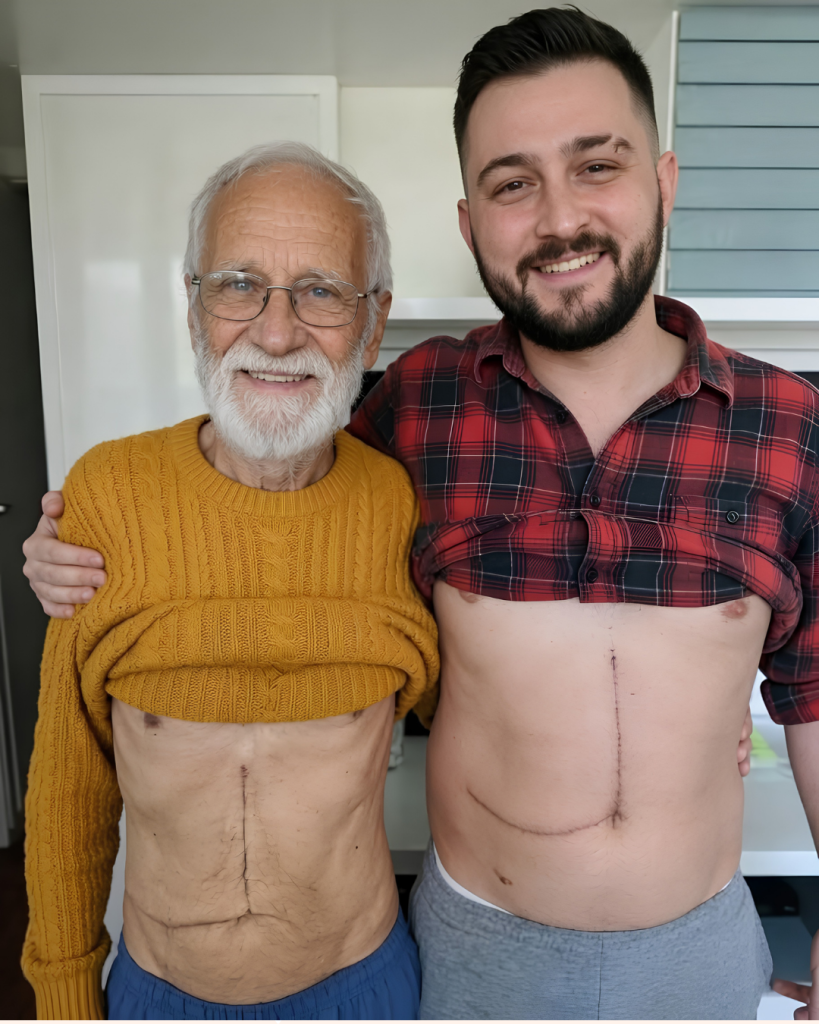
Years later, my scar remains.
I see it every morning.
Some people might see it as a reminder of pain and sacrifice.
I see something different.
I see extra birthdays.
I see family dinners.
I see laughter that almost never happened.
Most of all, I see my father.
Still here.
And if I had to make the same choice again, knowing every risk, every fear, and every painful step of recovery, I would do it all over in a heartbeat.
Because sometimes love asks us to give a piece of ourselves.
And sometimes, that piece becomes someone else’s second chance at life.